
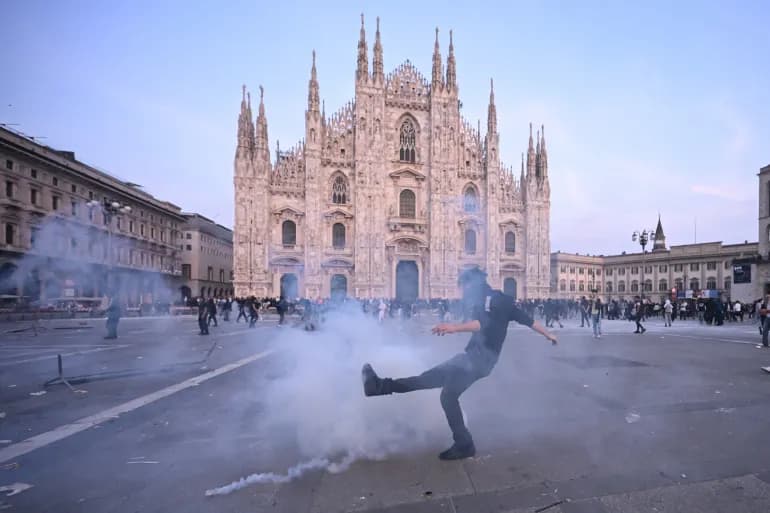
Police fired tear gas across the Piazza del Duomo in Milan on October 17 as cost of living protests that began peacefully turned into clashes, with demonstrators throwing stones and officers responding with crowd control measures more associated with riots than economic marches. Milan and Bologna both saw looting and fires break out alongside the unrest, and police detained roughly 50 people, many of them minors, with at least two officers reported injured.
Prime Minister Giorgia Meloni responded by drawing a sharp line between the demonstrations themselves and the violence that accompanied them, saying the right to protest was not in question but blaming what she called hooligans who exploit demonstrations to sow chaos for the looting and clashes. The distinction let her government avoid condemning the underlying cost of living grievance while still rejecting the specific scenes playing out in two of Italy's largest cities.
Italy's unrest was one piece of a far larger pattern across Europe that same day. France saw the biggest numbers by far, more than 550,000 demonstrators across cities including Paris, Marseille, Nice, Nantes, Bordeaux, Limoges, Lille, Toulouse and Strasbourg, where tear gas and water cannon met protesters, roughly 1,200 people were arrested and around 150 police officers were injured. Rioters set fires in public buildings and vandalized city halls in Marseille and Lille, and in Limoges a town hall standing for 140 years was destroyed. French Prime Minister Sebastien Lecornu said afterward that it was a miracle the toll was not higher.