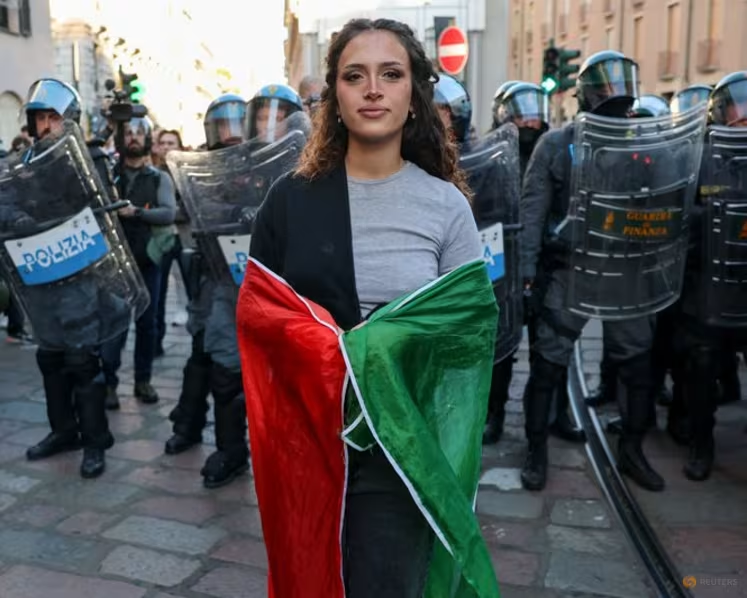
Italy Flooded Its Cities With Soldiers and Drones, and Saturday Mostly Stayed Peaceful
A week after looting and clashes hit Milan and Bologna, Italy met Saturday's cost of living marches with roughly 1,800 security personnel in Milan alone and drone surveillance in Rome. Milan stayed calm, but protesters briefly broke into the Colosseum and Turin saw short clashes with police.
Thousands of people marched through Milan, Rome and Turin on Saturday as Italy's largest security deployment in years met a new round of cost of living protests, a week after similar demonstrations in Milan and Bologna turned into looting and clashes with police. The result was mostly, though not entirely, the calm outcome the government had been preparing for.
Milan carried the heaviest security presence of any city. Roughly 1,800 personnel were deployed under the government's new security decree, about 1,000 police officers and Carabinieri, 300 municipal officers and 500 soldiers, backed by drone surveillance over the march route and an outright ban on gatherings in the Garibaldi and Porta Venezia districts. Several thousand marchers brought traffic in the city centre to a standstill, but the demonstration itself stayed peaceful, a contrast with the scenes that had damaged shops and clashed with riot police there just a week earlier.
Rome and Turin told a more mixed story. Roughly 1,500 officers were deployed in Rome, supported by police drones and Carabinieri aircraft, while the capital's Cybersecurity Centre and the specialized Digos police division monitored social media for signs of coordinated unrest. A similar-sized crowd to Milan's rallied there, and at one point some protesters briefly broke into the Colosseum before being moved on. Turin saw its own short clashes with police during the march, brief enough not to match the scale of the previous weekend's violence but real enough to show the security buildup did not guarantee a quiet day everywhere.
The scale of the response reflected how seriously authorities took the risk of a repeat. In the days after the October 17 and 18 unrest, the Digos division carried out searches targeting roughly 100 people, including 51 minors, across cities including Bari, Bergamo, Florence, Genoa and Verona, and investigators spent the following week tracking social media channels where users had circulated tactical advice on handling tear gas and confronting police lines. More than 30 separate protests were tracked across the country on Saturday, spanning grievances well beyond the cost of living, including education funding, corruption, pensions, housing and opposition to military spending.
What Saturday showed is that the government's law and order response, the troops, the drones, the new legal powers debated after the last round of unrest, worked as a deterrent in the city that had suffered the worst damage the week before, while doing less to prevent smaller flashes of trouble elsewhere. For a government that built its entire post Milan strategy around projecting control, a mostly peaceful Saturday with a couple of exceptions is closer to a win than a loss, even if it is not the clean outcome officials were hoping to claim.