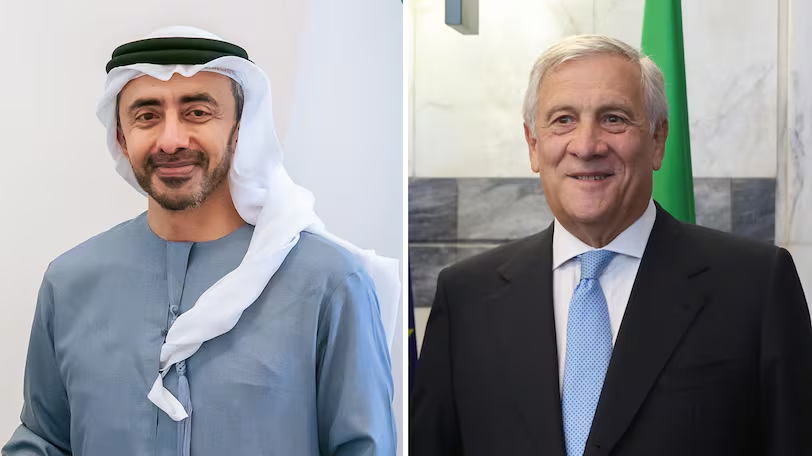
Tajani and the UAE's Sheikh Abdullah Talk Middle East Security, Without Saying Which Part of It
Italy's foreign minister Antonio Tajani and the UAE's Sheikh Abdullah bin Zayed held a phone call reviewing bilateral ties and reaffirming a shared commitment to regional stability. Neither side's public readout named a specific crisis, continuing a pattern of frequent, deliberately vague high level contact between Rome and the Gulf.
Italy's deputy prime minister and foreign minister Antonio Tajani spoke by phone on Wednesday with Sheikh Abdullah bin Zayed, the United Arab Emirates' deputy prime minister and minister of foreign affairs, in a call both governments described in almost identical terms, reviewing the state of bilateral relations and discussing the current situation in the Middle East. Neither side's public readout named a specific flashpoint to go with that language.
The call covered two tracks at once. On one, Tajani and Sheikh Abdullah discussed ways to strengthen the strategic partnership between Rome and Abu Dhabi, including economic development aligned with each country's own priorities, the kind of language used when two governments want to signal commercial cooperation without committing to a specific project or figure in public. On the other, both sides reaffirmed their commitment to promoting security and stability across the region and at the international level, a formulation broad enough to cover everything from Gaza to the Red Sea to Iran without obligating either government to take a position on any one of them publicly.
That vagueness is not unusual for this kind of call, and it fits a pattern that has defined Italy's Gulf diplomacy for most of this year. Rome has leaned on frequent, high level contact with Gulf governments, Crosetto's calls and meetings with Saudi Arabia's defense establishment chief among them, more than on announcing new programs or contracts in public. Wednesday's conversation follows earlier 2026 meetings between UAE President Sheikh Mohamed bin Zayed and Italian leadership, placing it inside an already established relationship rather than opening a new one.
What a call like this actually does is keep a channel open rather than settle anything. Italy has real, concrete interests in the region's stability, roughly 40 percent of its international trade moves through the Red Sea and Suez corridor that regional instability has repeatedly threatened, and a government with that much riding on calm waters has reason to stay in regular touch with every Gulf capital that can affect it, whether or not each individual call produces anything the public gets to see.