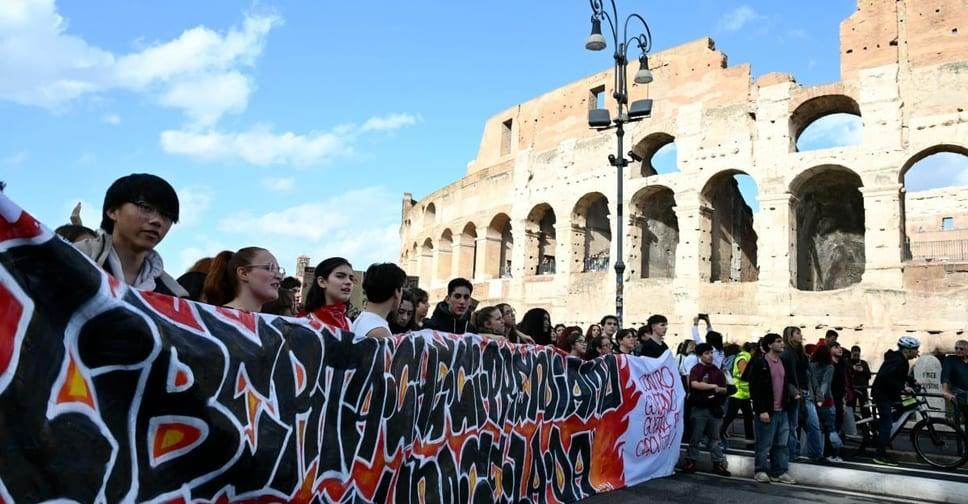
Thousands Join CGIL Strike Across Italy Over Wages and Public Spending
Students and workers took to the streets across Italy as the CGIL union staged a general strike against Prime Minister Giorgia Meloni's economic policies, calling for higher wages and more investment in public services.
Thousands of students and workers joined protests across Italy on Friday as the country's largest trade union, CGIL, staged a general strike. The mobilisation targeted the economic policies of Prime Minister Giorgia Meloni's government and demanded higher wages and greater investment in healthcare, education and public services.
The Italian protests formed part of a wider wave of youth mobilisation across Europe. Students also demonstrated in Germany, France, Britain, Austria and Belgium against rising living costs and increased military spending.
Why workers are striking
CGIL called a full-day general strike involving private and public sector workers, including schools and healthcare. Air and rail services were excluded from the general strike, while local public transport operated under minimum-service rules. A separate rail stoppage was scheduled to run from 9 pm on Friday until 8 pm on Saturday.
The union is demanding wage increases and contract renewals to recover purchasing power lost to inflation. Other demands include full pension indexation and measures to stop the retirement age from rising further.
Political reactions
Industry Minister Adolfo Urso described the strike as a "pre-emptive action," saying CGIL leader Maurizio Landini had called it before even seeing the contents of the budget bill. Urso added that he had "great respect for those demonstrating and for those who have tabled amendments in parliament, where the budget will then be improved."
The government is examining a 2027 budget worth €26 billion, about $30 billion. CGIL argues the sum is insufficient to support incomes and public services. The financial newspaper ItaliaOggi also noted that only a small fraction of the spending is targeted at under-35s.
Students speak out
Student protests accompanied the strike in cities across Italy. Young people are demanding more funding for education, relief from high housing costs and a reduction in military spending. The latter issue has become a rallying cry for continuing protests and occupations at schools and universities.
"We are living under a government that, piece by piece, is cutting healthcare and education, taking away our present and trying to rob us of our future," said Laura Peritore, 24, a university student. "We are making it clear that we will not back down and will take our future back."
The electoral backdrop
The demonstrations come as Italy moves toward parliamentary elections expected in 2027. The debate over wages, welfare and public spending is becoming one of the main battlegrounds of political competition. CGIL has stressed that the call for change extends beyond Italy to the whole of Europe.
"Today is a very important day because young people are taking to the streets not just in Italy but across Europe," Landini said. "Across Europe and among ordinary people, the demand for change is growing." He added that people face "very basic problems: they struggle to make ends meet and therefore need higher wages; they need a healthcare system that works; young people need schools that work. This budget does not address a single one of them."